Couples Therapy
Distance between two people rarely arrives all at once. It builds slowly, through conversations that never quite happen, disagreements that keep returning, and feelings that stay unspoken because neither of you knows how to begin.
You may still love your partner deeply. You may care about your marriage and the life you have built together. And yet something feels different. Conversations have become harder, small disagreements grow into larger arguments, and time together no longer feels as easy as it once did. If this sounds familiar, please know that you are not alone. Noticing the distance is not a failure. Often, it is a sign that you both care enough to want something better.
You may have wondered if couples therapy could help.
Couples therapy is a form of professional counseling in which partners work with a trained mental health professional to understand their relationship, explore recurring difficulties, communicate more openly, and work towards changes they choose together. It gives both people a structured, respectful space in which to be heard.
Couples therapy does not mean your relationship has failed. It can be a chance to understand what is happening between you, to address concerns that have been hard to resolve, and to make more thoughtful decisions about your future together.
In short: couples therapy is a guided, confidential process that usually begins with an introductory session, moves through understanding each partner's experience and your shared patterns, and then builds practical changes you can use between sessions. Research shows that, on average, couples who receive therapy report large improvements in relationship satisfaction, although every relationship is different and results cannot be guaranteed. It is not suitable as a starting point when one partner feels unsafe.
This guide explains what couples therapy is, what happens in a session, how it may help, what research says (including research from Nepal), and when it may be worth speaking to a couples counsellor in Nepal.
What Is Couples Therapy and How Does It Work?
Understanding couples therapy
Couples therapy, also called couple counseling or relationship counseling, is a process in which partners work with a trained mental health professional to understand and address difficulties in their relationship.
Rather than focusing on who is right and who is wrong, couples therapy looks at the relationship itself, and at the patterns that form between two people over time.
A counsellor may help you explore:
- How you communicate during disagreements.
- What happens when one partner feels hurt, ignored, criticised, or misunderstood.
- How emotional needs are expressed and how they are received.
- Why certain arguments keep returning.
- How trust, intimacy, and closeness have changed over time.
- How responsibilities, expectations, and life transitions affect your relationship.
- What each of you hopes to understand or change.
The purpose is not to make one person responsible for every difficulty. It is to help both partners understand their own experiences, recognise the patterns they share, and find realistic ways forward.
What couples therapy is not
Several misconceptions can make people hesitate before asking for the correct help. Couples therapy is not:
- A courtroom where one partner wins and the other loses.
- A place where the counsellor automatically takes one person's side.
- A guarantee that every relationship will stay together.
- A requirement to share every private thought on the first day.
- A process that assumes every couple has the same problem.
- A substitute for help when there is abuse, coercion, or an immediate safety concern.
The experience is collaborative. A counsellor guides the conversation, while both partners remain active participants in deciding what they want to understand and work towards.
Why couples consider counseling
Relationship difficulties can appear at any stage of a partnership. Some couples seek support after months or years of recurring conflict. Others notice a gradual loss of closeness. Some simply want to address a concern before it becomes harder to manage. You do not need to be on the edge of separation to ask for support.
Communication that keeps breaking down
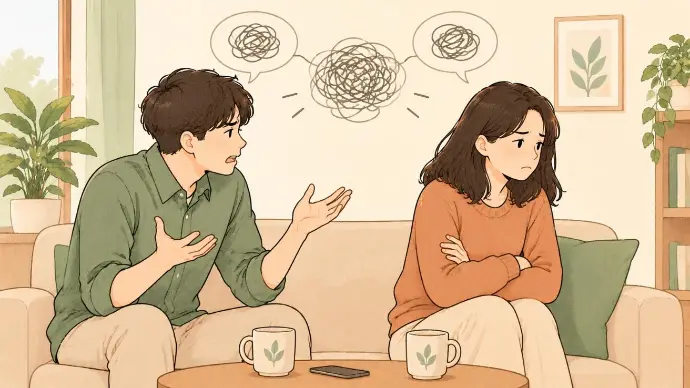
You may find yourselves having the same argument again and again without feeling understood. One of you tries to explain something important, and the other feels criticised or overwhelmed. The conversation turns defensive, and the original concern gets lost. Over time, both of you may stop raising difficult topics at all, because it feels safer to stay silent.
Feeling emotionally distant
You may share a home, a routine, and responsibilities, and still feel far apart. One partner may feel lonely inside the relationship, while the other may not realise how heavy that loneliness has become.
Changes in trust
Trust can become fragile after dishonesty, broken promises, secrecy, or an experience that left one partner deeply hurt. Rebuilding trust usually takes more than being asked to move on. It often requires understanding what happened, acknowledging its impact, and deciding together what meaningful repair would look like.
Different expectations about marriage and family
Partners may expect different things about household responsibilities, money, parenting, career decisions, family involvement, or personal independence. In Nepal, these conversations may also involve extended family expectations, living arrangements, migration, financial responsibilities towards relatives, and pressure around major life decisions.
These experiences are not the same for every couple. A counsellor can help you explore your own circumstances without assuming that any one cultural expectation should decide how your relationship works.
Major life transitions
Marriage, becoming parents, a change of job, moving to a new place, caring for a family member, or financial uncertainty can change the way two people relate to each other. Sometimes a couple is struggling not because their feelings have disappeared, but because they are still learning how to move through a new stage of life together.
Couples therapy and marriage counseling: are they different?
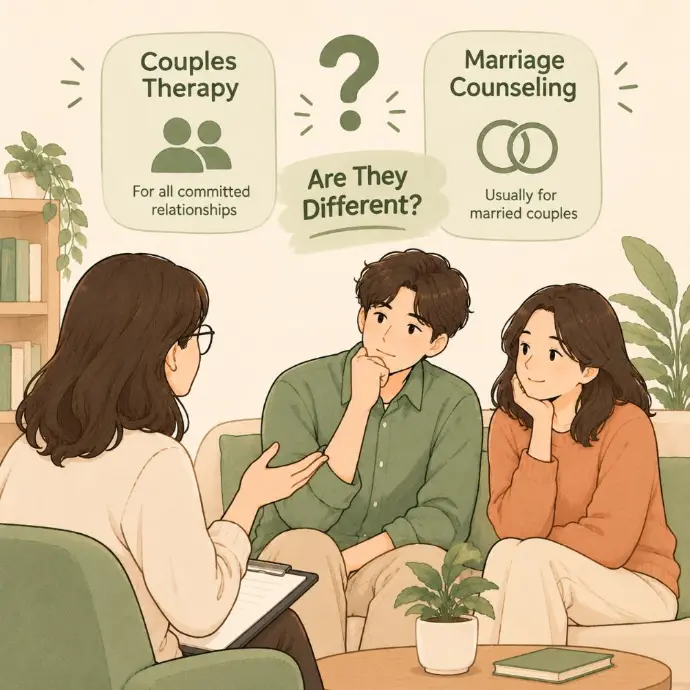
The terms couples therapy, relationship counseling, and marriage counseling are often used interchangeably. Marriage counseling usually refers to support for married partners, while couples therapy can include people in other kinds of committed relationships.
The focus is similar: understanding relationship difficulties, improving communication, exploring emotional experiences, and working towards agreed goals.
Neither term means that a relationship must continue, or that separation is the wrong choice. Professional support can also help partners approach difficult decisions with greater clarity and less fear.
What Happens in Couples Therapy Sessions?
For many people, the hardest part is not knowing what to expect. You may wonder if you will be asked to share your most painful experiences straight away, if your partner will become upset, or if the counsellor will push you to make decisions before you are ready. These worries are very common, and a good counsellor will expect them.
The process varies with the therapist, your concerns, and the goals you set together. Most couples, however, move through a similar set of stages.
1. The first session: getting to know your relationship
The first session focuses on understanding what has brought you to counseling. The therapist may ask:
- What made you consider couples therapy at this point?
- What has been difficult between you recently?
- What happens when you disagree?
- What do you wish your partner understood about your experience?
- What do you still appreciate about your relationship?
- What would you like to be different after working together?
Two people can describe the same situation very differently. Here is a simple yet effective example. One partner might say, "We never talk about anything important anymore." The other might say, "I try to talk, but every conversation turns into an argument."
Both statements can be true at the same time. A counsellor can hold both experiences without deciding too quickly that one is more valid than the other.
The first session is also your opportunity to learn how counseling works, to talk about your expectations, and to ask about the therapist's approach. You are allowed to take your time here.
2. Understanding each partner's experience
Your relationship is shared, but your experience of it may be very different. One partner may feel neglected while the other feels constantly criticised. One may look for reassurance through conversation, while the other withdraws because they feel overwhelmed.
The counsellor may invite each of you to describe what certain situations mean to you, how you feel during disagreements, and what you need from the relationship. This does not mean every behaviour is acceptable, or that both partners carry equal responsibility for every problem. It means that the experiences are understood before anyone decides how to respond.
3. Exploring recurring patterns
Many couples are caught in a familiar loop. Consider this illustrative example. One partner wants to discuss an unresolved concern and raises it repeatedly because they feel unheard. The other experiences these conversations as criticism and pulls back. The first partner then feels even more ignored and tries harder to get a response.
Both end up hurt, though neither wanted the conversation to go that way.
A therapist can help you see this pattern and understand what happens at each step. The question slowly changes from "Why are you always like this?" to "What happens between us when this subject comes up?" That shift can make it easier to address a problem without turning every conversation into a judgement of each other's character.
4. Learning to communicate more clearly
Good communication is not simply talking more. It also involves listening, understanding emotional reactions, expressing needs, and noticing when a conversation has become too heated to continue. A counsellor may help you practise:
- Raising concerns without sweeping statements about your partner's character.
- Listening to understand, rather than preparing a reply.
- Describing what a situation felt like for you.
- Asking questions instead of assuming intentions.
- Recognising defensiveness or withdrawal when it begins.
- Taking an agreed break, and returning to the conversation afterwards.
For example, instead of saying, "You never care about what I say," a partner might practise saying, "When I try to explain something important and the conversation ends quickly, I feel alone with it. I would like us to spend some time understanding each other."
The second sentence does not guarantee a better response. It does, however, express the concern more clearly and gives the conversation a gentler starting point.
5. Working through difficult emotions
Conflict often carries feelings that are not immediately visible. Anger may sit on top of disappointment. Withdrawal may be a way of coping with feeling overwhelmed. Repeated requests for reassurance may come from uncertainty about the relationship.
A therapist can help you explore these feelings carefully, including:
- What makes a particular disagreement feel so painful?
- Which experiences have affected trust?
- What do each of you find hard to say aloud?
- How earlier life and relationship experiences shape present reactions?
- What helps each of you feel understood?
- Which emotional needs remain unmet?
These conversations can feel uncomfortable. That does not mean you are doing therapy wrongly. A helpful therapeutic space should allow difficult experiences to be shared while both of you are treated with respect.
6. Setting relationship goals
Therapy becomes more useful when you know what you are working towards. Your goals might include:
- Having difficult conversations without it escalating into arguments.
- Understanding each other's emotional experiences.
- Rebuilding trust after a painful event.
- Spending more meaningful time together.
- Addressing disagreements about family responsibilities.
- Restoring affection and closeness.
- Making important decisions about the relationship more thoughtfully.
Your therapist can help turn broad hopes into specific areas of work. "We want to stop fighting" might become, "We want to understand why conversations about money become hurtful, and find a way to discuss financial decisions without blaming or withdrawing." Specific goals give both of you something real to work on between sessions.
7. Practising changes between sessions
Couples therapy is not limited to the appointment itself. Depending on the therapist's approach, you may be encouraged to practise certain communication skills, notice recurring patterns, or set aside time for a conversation that has been hard to begin. These activities should fit your relationship and be manageable within your daily life. You might practise:
- Checking in with each other about how the week has felt.
- Discussing one concern at a time.
- Listening without immediately offering solutions.
- Expressing appreciation in ways that feel genuine.
- Noticing what happens just before an argument escalates.
- Returning to an unresolved conversation at an agreed time.
These are not tests of how good a partner you are. They are chances to see how small changes affect the way you relate to each other.
8. Reviewing progress and adjusting the approach
As therapy continues, the counsellor will revisit your goals and ask what has changed. You may notice that disagreements still happen but no longer feel as overwhelming. You may understand each other's reactions better, or find that a conversation that once felt impossible is now approachable. Progress can also mean recognising a concern that needs more attention.
If something is not helping, a good therapist will talk with you about adjusting the approach or the goals. There is no universal number of sessions. The length of therapy depends on the concerns involved, the goals you set, the approach used, and how the process unfolds for the two of you.
How Couples Therapy Can Help Your Relationship
Couples therapy is not about building a perfect relationship. Every partnership involves differences, disagreements, and moments of misunderstanding. What matters is how two people respond to those moments, and if they can raise concerns in ways that feel respectful and safe.
Improving communication and understanding
When conversations keep turning defensive, it becomes hard to hear what either person is really trying to say. Therapy helps partners notice these patterns and practise saying things more clearly. Over time, it may become easier to raise concerns, name emotional needs, and respond to disagreements with more awareness.
Understanding conflict instead of only avoiding it
A relationship without arguments is not always a healthy one. Some partners avoid difficult topics because they fear upsetting each other or starting another fight. Couples therapy can help you tell the difference between avoiding conflict and learning to face it constructively. The aim is not to remove every disagreement. It is to understand what happens during one, and to respond in ways that do less damage to the relationship.
Rebuilding emotional connection
Closeness is hard to keep when partners feel unheard or misunderstood. Therapy can create room to explore what each person misses and what helps them feel connected. For some couples, that means making time for meaningful conversations. For others, it means understanding why affection has changed, or addressing hurt that was never resolved.
Addressing trust and repair
When trust has been damaged, both partners may need time. The partner who was hurt may need acknowledgement and consistency. The partner who caused the hurt may need to understand its impact and take responsibility through meaningful change. A counsellor can guide these conversations, while recognising that trust cannot be restored simply because a certain number of sessions have passed.
Making important decisions with more clarity
Some couples begin therapy because they are unsure about the future. They may be considering separation, struggling with commitment, or trying to understand if real change is possible. Therapy offers a space to explore these questions without rushing towards a fixed answer. For some couples, the goal is to improve the relationship. For others, it is to understand their options and decide more thoughtfully.
What Does the Research Say About Couples Therapy?
It helps to separate what research can tell us from what anyone can promise about your own relationship. Research describes what tends to happen on average. It cannot predict what will happen for one particular couple.
Global research
A 2020 meta-analysis in the Journal of Consulting and Clinical Psychology combined results from 58 studies, covering 40 unique samples and 2,092 couples. The researchers found that couple therapy had a large effect on relationship satisfaction, while couples placed on waiting lists did not improve significantly. They also found benefits in communication, emotional intimacy, and partner behaviours, with gains generally maintained at short and long-term follow-up. Couples who were more distressed at the start tended to gain more. The authors noted one important limitation: the studies included only opposite-sex couples. (Roddy et al., 2020)
Other research urges a measured view. A 2019 meta-analysis of randomised controlled trials of two well-established approaches, behavioural couple therapy and emotionally focused couples therapy, found medium improvements in relationship satisfaction straight after treatment. The improvements were smaller six months later, and the behavioural therapy gains were not maintained at 12 months. The authors also cautioned that publication bias may affect the results. (Journal of Marital and Family Therapy, 2019)
Taken together, the evidence suggests that couples therapy can help many couples, that results vary, and that keeping up new habits after sessions matters.
Research from Nepal
Research from Nepal does not yet tell us how well couples therapy works locally. It does, however, show how closely relationship experiences and mental well-being are connected here.
Spousal relationship quality and depression. A longitudinal study in SSM - Mental Health followed 200 newly married women aged 18 to 25 in Nawalparasi district. The women were recruited within four months of marriage, were living with their mothers-in-law, and were interviewed four times at six-month intervals between 2018 and 2020. Better relationship quality with the husband was associated with lower depressive symptoms. A better relationship with the mother-in-law was also associated with lower symptoms, and it influenced how strongly the spousal relationship was linked to depression. The authors point to husbands and mothers-in-law as important people in the mental health of newly married women. (Gopalakrishnan et al., 2023)
Marriage, context, and depression. The Chitwan Valley Family Study followed 10,516 participants in a setting with many arranged marriages and very little divorce. It found that moving into marriage was associated with higher odds of later depression (a median odds ratio of 2.28), especially among women. (Chitwan Valley Family Study) One of the study's authors has also reported that experiencing domestic violence raised the odds of depression among both men and women. (University of Michigan Institute for Social Research)
These are observational studies. They show associations, not proof that one thing caused another, and neither one tested couples therapy. What they do suggest is that marriage does not automatically protect well-being, and that the quality of a relationship, the safety within it, and the family context around it all matter.
Is Couples Therapy Suitable for Every Relationship?
Couples therapy can help with many relationship concerns, but not all of them. This matters most when a relationship involves fear, coercion, abuse, or threats.
When safety needs to come first
If you are experiencing physical violence, sexual violence, intimidation, coercive control, or threats, joint counseling may not be a safe place to begin. Speaking about your experiences in front of the person who is harming you could expose you to more harm or pressure afterwards.
If you feel unsafe in your relationship, please speak to a professional on your own first and put your safety ahead of any decision about joint counseling. A responsible therapist will assess suitability carefully instead of automatically asking both partners to attend together.
Couples therapy is also not a substitute for urgent help. If you are in immediate danger, contact your local police or emergency services. In Nepal, women experiencing violence can call or send an SMS to the National Women Commission helpline on 1145 (toll free)
Couples Therapy in Nepal: Understanding Relationship Concerns in Context
Relationships in Nepal often involve personal wishes alongside family, social, and cultural responsibilities. Many couples are navigating:
- Expectations from parents and extended family.
- Different views on family involvement and boundaries.
- Financial responsibilities towards relatives.
- Decisions about living with family or separately.
- Work opportunities, and the separation that migration can bring.
- Expectations about marriage, parenting, and household roles.
- Different ways of expressing emotion or handling conflict.
These pressures affect couples in different ways. A thoughtful counsellor will not assume that every couple wants the same family structure, lifestyle, or definition of a successful marriage. One partner may value close involvement with extended family, while the other needs more privacy and independence. Neither wish is automatically right or wrong. Often, the real need is for both partners to understand each other's needs, boundaries, and responsibilities more clearly.
Couples counseling can help you explore these differences while respecting each person's experience and circumstances.
How to Know If Couples Therapy Might Be Right for You
You may want to consider relationship counseling if:
- The same disagreements keep returning without resolution.
- You find it hard to talk about important concerns.
- You feel emotionally disconnected from your partner.
- You want to rebuild trust after a painful experience.
- You struggle to understand each other's emotional needs.
- You are moving through a major life transition together.
- You want to address concerns before they become harder to manage.
- You need support to understand where your relationship is heading.
You do not have to point to one big problem before asking for help. Sometimes the reason is simply that you miss feeling close.
How to Prepare for Your First Couples Therapy Session
Preparing does not mean rehearsing a speech or collecting evidence against your partner. A little reflection can help you feel steadier going in.
Think about what has been difficult
Consider which conversations feel hardest, which concerns remain unresolved, when you feel most connected to your partner, what you wish your partner understood, and what you would like to change about the way you communicate. You do not need complete answers.
Remember what you appreciate
It can help to remember what you value in your partner and your relationship. This does not mean ignoring painful experiences or pretending everything is fine. It simply gives you a fuller picture of the relationship beyond its difficulties.
Be open about your expectations
One of you may hope to feel understood, while the other may hope for practical change. Talking about these expectations early helps the counsellor understand what each of you wants from therapy.
Ask questions about the process
You can ask the therapist about their approach, how sessions are structured, how confidentiality works, and how they support couples who see things differently. Knowing what to expect can make the first session feel less daunting.
How Saharamind Can Support Couples Seeking counseling
If you and your partner have been finding it hard to talk through relationship concerns, professional support can give you a calmer place to have those conversations.
At Saharamind, couple therapy is designed to help partners work through relationship challenges with a therapist experienced in couples work. The process begins when you share some information about the concerns you are facing. This is followed by an introductory session in which you and your partner meet the therapist and agree on shared goals. Sessions then continue at a pace that suits your relationship and the work you want to do.
You can learn more about couples therapy at Saharamind, or browse Saharamind's therapists to see their areas of experience.
You do not need to wait until every conversation feels difficult. Sometimes the first step is simply being willing to understand each other a little better.
Frequently Asked Questions About Couples Therapy
What happens during a couples therapy session?
A session usually involves talking about your relationship concerns, understanding each partner's experience, identifying recurring patterns, and exploring ways to communicate more effectively. The therapist guides the conversation, helps each of you express your needs, and works with you towards shared goals. The exact structure depends on the therapist's approach and the concerns involved.
How many sessions of couples therapy do we need?
There is no fixed number that suits every relationship. Some couples come for a specific concern, while others need more time to work through recurring difficulties, rebuild trust, or pursue broader goals. Your therapist can review your progress with you and talk about the right length of therapy.
Can couples therapy help if we argue frequently?
It may help you understand why the same disagreements keep happening and how your communication patterns feed the conflict. The aim is not to end all disagreements, but to help you handle them in ways that are less hurtful and more constructive.
Can couples therapy help us rebuild trust?
Therapy can help you explore what damages trust, understand its impact, and identify what meaningful repair would involve. Rebuilding trust takes time, and it depends on the circumstances, the willingness, and the actions of both people. Attending sessions alone cannot guarantee it.
Do we both need to attend couples therapy?
Couples therapy generally involves both partners, because the work focuses on the relationship. If your partner is not ready to attend, individual counseling can still help you understand your experiences and think through how you want to approach your concerns.
Does couples therapy mean we are going to separate?
No. Many couples come because they want to understand their relationship and improve it. Some also use counseling to think through difficult decisions. Therapy does not decide for a couple if they should stay together or separate.
Is couples therapy confidential?
Counseling involves professional confidentiality, but its limits depend on the law, professional obligations, and the circumstances. Before you begin, ask your counsellor how confidentiality works in joint sessions, how individual disclosures are handled, and what exceptions apply. You can also read Saharamind's Privacy Policy to understand its privacy practices.
Is couples therapy available online in Nepal?
Yes. Saharamind offers online couple therapy, so both partners can attend together from their own locations. You can read about the couple therapy service to understand the process and arrangements.
A Relationship Does Not Have to Reach Breaking Point Before You Ask for Support
Relationships can be meaningful and difficult at the same time. You may love your partner and still feel hurt. You may want to stay together and still struggle to understand each other. You may have spent years building a life together and now find it harder to talk about what matters most.
None of this makes your relationship meaningless, and none of it means you have failed as partners.
Couples therapy offers a chance to pause, understand what has been happening, and explore what you both need. Sometimes that means learning to communicate differently. Sometimes it means addressing hurt that was never resolved. Sometimes it means making a decision that is difficult but important. You do not have to figure everything out before you ask for help.
If you feel ready to explore what support could look like, Saharamind is here to help you take that first step. Explore couples therapy at Saharamind and learn how you and your partner can begin working towards a relationship that feels more understanding, connected, and supportive.